
Devlog #3 – Rebuilding the World of Age of Failon
It has been a long time since the last Age of Failon devlog, but development certainly hasn’t stopped.
Over the past months, Age of Failon has gone through some of the largest changes since development began. Many of the game’s core systems have been redesigned, the progression system has been rebuilt, and the world itself looks very different from the version shown in our previous devlogs.
Today, I want to start with the most immediately visible change: the world of Age of Failon has been completely rebuilt.
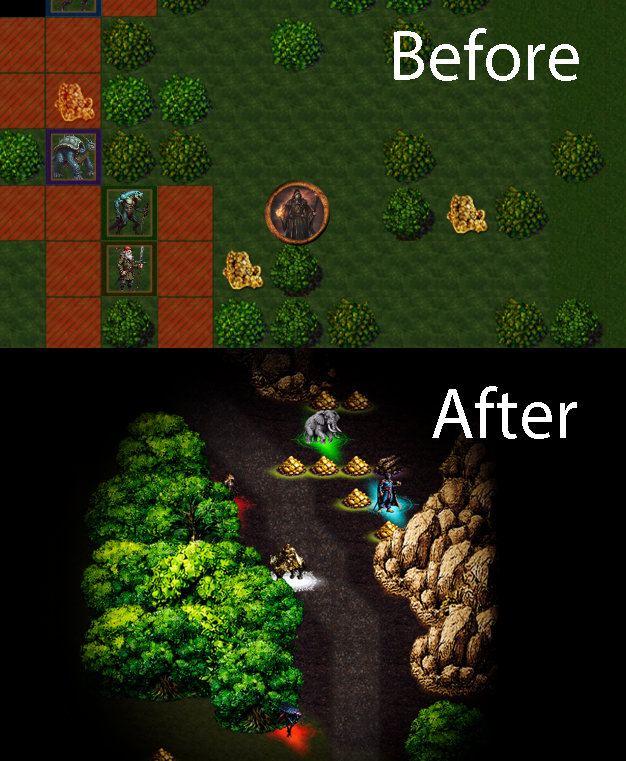
From a Flat Grid to a Top-Down Fantasy World
The original world map was built around a very visible square-grid presentation. Terrain was divided into clearly recognizable tiles, and while the system worked from a gameplay perspective, the world often felt more like a game board than an actual fantasy landscape.
The grid is still an important part of Age of Failon’s gameplay, but it no longer needs to dominate its visual presentation.
The new world uses a much more natural top-down perspective, while movement and gameplay continue to operate on the underlying square grid.
This allowed me to keep the deterministic movement and strategy systems while making the world itself feel considerably more alive.
Shader-Based Terrain
One of the biggest technical changes was replacing much of the old tile-based terrain presentation with a new shader-based system.
Terrain textures can now blend and tile much more naturally across the world instead of appearing as isolated squares.
The terrain shader was also designed with procedural generation in mind. Age of Failon contains hundreds of maps, so the solution cannot depend on manually creating beautiful terrain for every individual map.
The world generator needs to create it automatically.
The fog system was reworked alongside the terrain to better fit the new visual style and the top-down presentation.

Rebuilding the Environment
Changing the terrain exposed another problem very quickly: many of the old world assets no longer matched it.
So the environment received a much larger rework than originally planned.
Trees, mountains, rocks, decorations, resources and other world objects have been replaced, redesigned or repositioned to better fit the new perspective.
Neutral buildings have also received their own structures and are now integrated directly into the generated world.
The result is not simply a new terrain texture placed underneath the old game.
The entire visual composition of the world has changed.
A Smarter Procedural World
The visual rework happened alongside major changes to the procedural world generator.
Age of Failon now generates multiple layers of the world while taking the structure of the map into account.
Road networks connect important areas of the map, buildings have placement requirements, decorations respect occupied spaces, and the generator analyses different areas before deciding where certain objects should appear.
This is especially important for Age of Failon because the campaign is built around 357 maps.
Creating hundreds of maps manually would not only be impractical, it would also make maintaining and balancing the campaign extremely difficult.
Instead, each map is generated from controlled rules and deterministic data while still allowing the world to provide variation throughout the campaign.
There is much more happening behind this system — including road generation, semantic analysis and balance-driven placement — and I will cover the procedural generation system itself in a future devlog.
This Was Only the Beginning
The world wasn’t the only part of Age of Failon that changed.
The interface has received a complete dark fantasy redesign, the old progression model has been replaced by a new card-based economy, maps now contain objectives and story events, combat has been heavily reworked, and the first part of Failon’s story is now fully integrated into the game.
There is a lot to show.
In the next devlog, I will focus on another immediately visible transformation:
the complete UI redesign of Age of Failon.