
Devlog #6 – Objectives: Changing How Age of Failon Maps Are Played
In the previous devlog, I introduced the new progression system of Age of Failon and explained how your hero, army and castle continue to develop across a campaign of 357 maps.
But rebuilding progression raised another important question:
What should actually happen during each of those maps?
Earlier versions of Age of Failon were much closer to the traditional strategy structure of placing heroes into a world and allowing them to compete for resources, armies and territory.
The new campaign needed something different.
This led to the creation of the Map Objectives system.
Every Map Has a Purpose
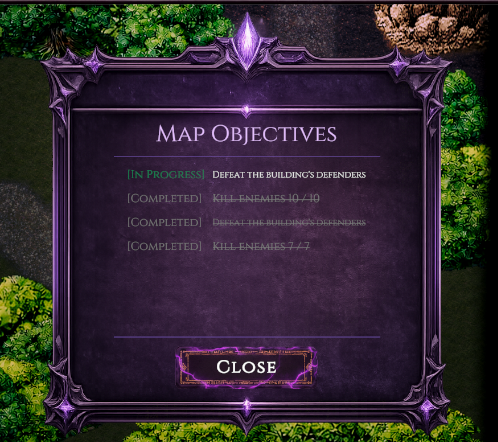
Maps in Age of Failon are now built around a sequence of objectives.
Instead of simply entering a map and defeating everything you encounter, the player receives specific goals that gradually move the scenario forward.
Objectives can include tasks such as:
- Kill Enemies – defeat a required number of enemy armies.
- Defeat Building – attack and defeat the army protecting a specific location.
- Collect Resources – gather required resources from the world.
- Build in Castle – construct or upgrade parts of your castle.
- Defeat Enemy Hero – face a hostile hero connected to the current scenario.
Completing an objective can unlock another objective, activate locations or trigger events elsewhere on the map.
A map therefore becomes a sequence of events rather than one static battlefield.

The World Can React to Your Progress
One of the most important parts of the new system is that the state of the map can change while you are playing it.
A location that initially has no importance may become part of a later objective.
A guarded building can become your next target.
A story event can trigger after completing a task.
And an enemy hero can enter the map because of something the player has done.
This allows scenarios to develop progressively instead of revealing everything immediately when the map begins.
The objective system also connects directly with the story system, allowing dialogue and gameplay events to happen at specific moments during a scenario.
Enemy Heroes Work Differently
Enemy heroes still exist in Age of Failon, but their role has changed.
Rather than every map beginning with several heroes independently exploring the world and building their own economy, enemy heroes can now be introduced as part of the scenario.
An enemy commander may appear after an objective is completed.
Once active, that hero can move through the world and pursue their own objective, including moving toward the player.
This gives me much more control over when and why an important encounter happens while still keeping the actual movement and battle inside the normal strategy systems.
It also makes enemy heroes useful as storytelling tools.
A commander isn’t simply another army randomly wandering around the map.
Their arrival can mean something.
Objectives Connect the World and the Castle
Not every objective happens directly on the world map.
Because the castle is part of the persistent progression system, objectives can also require the player to develop it.
You might need to gather resources first and then use them to construct or upgrade a specific building.
This connects several systems together:
exploration → resources → castle development → objective completion → new event
Instead of the world map and castle behaving like two largely independent parts of the game, actions in one can directly influence progression in the other.
Objectives and Rewards
Objectives are also closely connected to the new reward economy introduced in the previous devlog.
Exploration and battles provide opportunities to obtain resources and progression rewards, while completing the scenario moves the campaign forward.
This means the player is constantly making decisions about how much of the map to explore before completing the current goals.
A direct route may progress the story faster, while additional exploration can strengthen your hero and army for what comes later.
And because your progression continues into future maps, rewards you discover now can remain valuable long after the current scenario has ended.
Building Story Through Gameplay
The biggest reason for creating the objective system wasn’t simply to give the player a checklist.
It was to create a framework where gameplay and story could work together.
Dialogue can introduce a problem.
That problem becomes an objective.
Completing it can trigger another conversation, reveal a new threat or introduce an enemy commander.
The next objective then continues from what just happened.
This structure is already being used in the opening part of the campaign.
The first five maps now contain a complete sequence of objectives and story events following Failon and Gudin as they respond to the invasion of northern Kalgerion.
And as the campaign continues, the same system can support increasingly complex scenarios.
More Than 357 Empty Maps
Having 357 maps only matters if progressing through them continues to create new situations.
The objective system is one of the foundations that makes that possible.
Procedural generation creates the physical world.
The progression system determines how the player grows.
Objectives determine what is happening in that world.
And the story provides the reason for doing it.
These systems are designed to work together rather than exist as separate features.
In a future devlog, I’ll go deeper into how the procedural generator builds the worlds where all of this takes place.
But next, it’s time to return to another major part of Age of Failon that has changed significantly:
the Battle System.