
Devlog #9 – Bringing the Story of Failon to Life
For the last several devlogs, I have talked about systems.
A new world. A new progression model. Map objectives. Battles. The castle. Four Ages and hundreds of units.
But there was still something missing.
A reason for the journey.
Age of Failon was always intended to have a larger world and story behind its campaign. Over the past months, that story has finally started becoming part of the game itself.
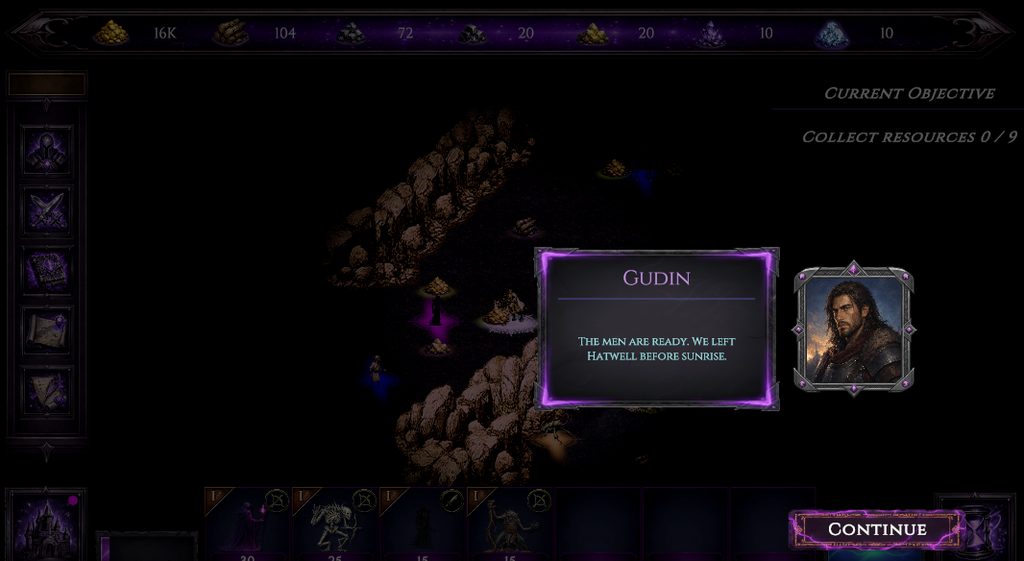
Characters now speak during maps, objectives can advance the narrative, important events can change what is happening in the world, dialogue is voiced, and the game begins with a cinematic introducing the conflict that starts Failon’s journey.
Birth of the Hero
The full title of the game is:
Age of Failon: Birth of the Hero
And the campaign begins before Failon is the hero he may eventually become.
The northern lands of the Kingdom of Kalgerion are under attack.
A barbarian warlord named Holgmond, once driven from the kingdom as a traitor, has spent years gathering strength beyond its borders.
Now he has returned.
His armies are moving through northern Kalgerion, settlements are falling, and the invasion is beginning to threaten the kingdom itself.
King Eldar needs someone to travel north, determine the scale of the invasion and stop Holgmond’s advance.
That task falls to Failon.
Failon and Gudin
Failon does not begin his journey alone.
One of the most important characters during the opening campaign is Gudin, an older and far more experienced warrior who accompanies him into the north.
The two characters approach situations differently.
Failon is a young military commander: intelligent, confident and willing to make decisions quickly.
Gudin is older, pragmatic and battle-hardened.
Their conversations are used throughout the opening maps to react to what the player discovers and to provide context without separating the story completely from gameplay.
Instead of reading a large wall of exposition before entering a scenario, the player can learn about events while actually progressing through the map.
Story and Objectives Work Together
The Map Objective system introduced in Devlog #6 was designed with story integration in mind.
Dialogue can introduce an objective.
The player then completes that objective through normal gameplay.
Its completion can trigger another conversation, activate a location, reveal new information or introduce another threat.
For example, Failon and Gudin may discover evidence of enemy activity.
That discovery becomes something the player needs to investigate.
What they find there can then change the next objective.
This creates a simple loop:
Story → Objective → Gameplay → Event → Story
The narrative is therefore not a completely separate layer sitting on top of the strategy game.
It can directly control how a scenario develops.
The Opening Five Maps
The first complete implementation of this system covers the opening five maps of the campaign.
Failon and Gudin travel through northern Kalgerion while responding to Holgmond’s invasion.
The journey takes them through:
Hatwell
Oglecaster
Toumont
Zrenpolis
Maswell
Across these maps, the player gradually learns more about the invasion while fighting enemy armies, securing important locations, gathering resources and facing hostile commanders.
These five maps also form the opening section currently being prepared for the Age of Failon demo.
They are intended to introduce not only the story, but also the core progression systems that will continue throughout the full campaign.
Characters Have Voices
Dialogue is no longer text-only.
The story system now supports fully voiced conversations.
Failon and Gudin have their own voices, and additional major characters are voiced as they appear throughout the story.
The goal wasn’t to create exaggerated fantasy performances where every sentence sounds like a dramatic trailer.
I wanted the characters to sound like people actually speaking to each other.
Failon should sound like a young commander.
Gudin should feel older, rougher and more experienced.
King Eldar should carry authority without needing to shout.
The voices are there to give the characters identity while allowing dialogue to remain relatively short and integrated into gameplay.
A Cinematic Beginning
The game now also begins with an opening cinematic.
Before the player enters the campaign, the cinematic establishes the situation in Kalgerion and introduces several of the characters behind the opening conflict.
Holgmond’s return.
The attack on the kingdom.
King Eldar’s response.
Failon’s decision to travel north.
And the beginning of the journey that will eventually turn him into the character behind the title of the game.
The cinematic combines narration, character dialogue, music, environmental audio and subtitles to establish the atmosphere before control is given to the player.
From there, the story continues inside the actual maps.

More Than a Sequence of Maps
This is also why the 357-map structure discussed in previous devlogs is important.
Those maps aren’t intended to exist as hundreds of unrelated scenarios.
They form Failon’s journey.
Characters can return later.
Conflicts can develop over multiple regions.
Events from earlier parts of the campaign can provide context for what happens much further into the game.
And because the same hero and army persist throughout the campaign, the player’s mechanical progression happens alongside Failon’s journey through the story.
At the beginning, both are relatively inexperienced.
Hundreds of maps later, neither should resemble where they started.
The Journey Has Started
The story implementation is still only at the beginning compared with the scale planned for the full campaign.
But the foundations are now working.
Story events can interact with objectives.
Characters can appear during gameplay.
Dialogue is voiced.
The opening cinematic introduces the conflict.
And the first five maps already combine these systems into the beginning of Failon’s campaign.
Age of Failon is no longer just about building a powerful army.
It is becoming the story of the person commanding it.

Next, I’ll return to the game itself and look at many of the smaller changes that have accumulated while preparing Age of Failon for players:
Devlog #10 – Preparing Age of Failon for the Demo.